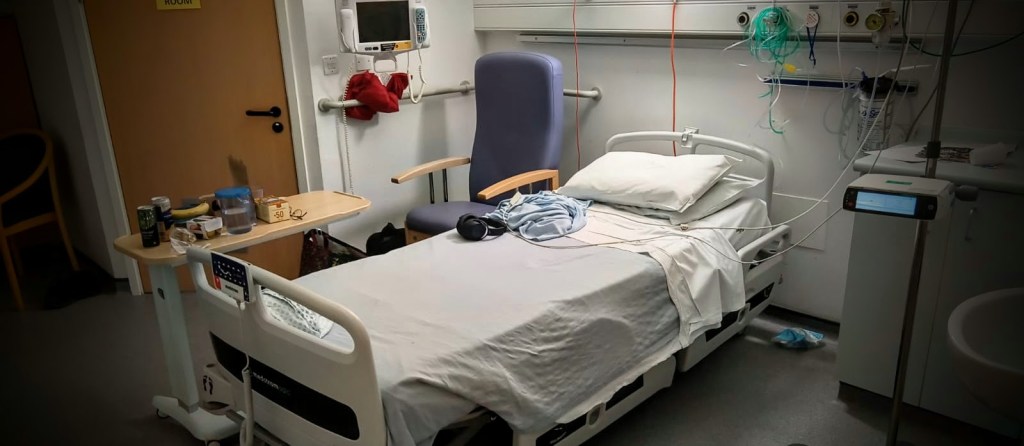
Hello friends. Today’s slightly longer blog describes four moments from two weeks in a hospital bed. A short health update appears at the end. I hope you enjoy the read: about 17 minutes.
I. Devoted
It’s mid-afternoon on US election day and the BBC have gone to a small town in Georgia, as far as I remember, looking for passers-by to speak a word on their vote. Or maybe it’s Ohio, Wisconsin… I don’t remember. We’re in a little public park squared with quiet residential streets somewhere near the middle of town. The first November leaves are beginning to drape the ground in gentle colours. It’s that moment of the turning season when some have their coats on while others hold out a few days more.
The vox-pops come thick and fast and I’m plunged into an impressionistic haze of America. Three distinct impressions, to be precise, which emerge from the varying attitudes of the passers-by. In one, loose, group are the fair few folks who sort of shrug, as if the election has landed them with an awkward extra chore when they’re already a bit busy with other stuff. They reel off how they voted as if they’d just picked whichever main looked tastiest from a restaurant menu, or least unpalatable. They tend to be well made up: smart, a bit bored, insular, haven’t thought about it a lot, and then they’re on their way. Their apparent indifference to the common future of their society, honest though it is, is unsettling to watch.
A second, smaller group tend to be a bit younger, dressed-down, and palpably alarmed at what might be about to happen to their country. They have friends, they tell the camera, that a Trump presidency would push under as the services they rely on are cut. They know immigrants who Trump calls ‘mental asylum people’ who would be deported. They’ve been thinking and worrying for people outside their own immediate circle because, it seems, this is how they think political decisions should be made. Their passion rocks me. It’s refreshing, hopeful, though borders on desperate. I find myself feeling for them, glad of their leaven in the American dough, and want to encourage them to keep caring.
A third impression, and this is the the one I most want to carry with me, comes from a brief interview with a working mum. She’s sat on the park bench with downturned mouth, holding two or three strawberry-blond tweenage kids. Her arm wraps around her older son as she chats, rubbing his forehead gently with her thumb, while he, camera-shy, stares at the ground. The autumn breeze lifts his locks a little.
The woman declares in a slow, southern drawl that she’s voted Trump. Asked why, she shrugs. ‘A little more money in the pocket will help some,’ she says, expecting tax cuts. ‘Buy the kids some new shoes. It helped a bit last time. Maybe it’ll be a bit more this time.’ She doesn’t sound sure, but it’s the bet she’s made. As I listen, I imagine her life feels full enough already with more important things than her vote, but she’s clear about why she cast it the way she did. It was for her children.
I can’t know this woman’s life, but the impression she leaves is of quietly knowing exactly what counts in it – her family – and what she needs to care for them – a bit more money in the pocket. I don’t imagine this hard-worked mum speaking up for the stranger in her midst. I don’t imagine either that she doesn’t care about them. I guess only that, for a long time, care beyond her own family has often felt beyond reach, unaffordable. And yet her love seems clear, non-negotiable, with no political pretention beyond itself. She shrugs again, as if all that need be said be said.
Four years down the line and I wonder if the bench the mother sits on will still be there, after Trump’s ten-pound hammer crushes the budget for parks and rec. But not a bone in my body wants to argue with her. I hope against hope that she and her children get what they need from a Trump presidency. Maybe they will.
A moment comes back to me from Kamala Harris’ gracious, and no doubt personally painful, concession speech on the steps of Howard University the following day. She holds her arms in front of her with a warm smile, as far as I remember, and appeals to America gaze into the lines of a stranger’s face and see your neighbour there. To my ear, those words speak to the essence of a shared future worthy of the word. But the breezy ease with which they’re so often said, as if what they point to is obviously right and easy – a presumption of which I too have many times been guilty – must madden the mum I’ve just met on the park bench.
To love the stranger as one’s neighbour is hard. It might get easier for those of us who’ve wrested ourselves free of the grind, usually by dint of some privilege, and now enjoy the existential elbow room to ponder the future as an equitable hope, something to hold in common. But I doubt it ever stops being hard if you’re pounding the breadline daily. The presumption that it ought to be otherwise – not that we can care for our neighbour, but that we all, obviously ought to – seems to have alienated so many marginalised Americans as to leave the Democrats high and dry on election night.
And I’m left telling myself what I should already know: don’t make the mum on the bench stupid, don’t make her the sort who ‘don’t look up’. It’s a terrible mistake, all the worse for being a righteous mistake – of which I for one will now always hope to repent.
II. Born into
Recalling a café chat with my wise friend Anne – mathematician, professor emerita, Quaker – I remember us landing on the question of what schools are for. And what they could be for. Depending on how favourably you shine on the idea of ‘schooling’, which likely depends in turn on your politics, schools are either essential for supporting young people to navigate the adult world to come, or merely the means by which we ready them for economic use. It’s a question of intention and outcome, and debate rages eternally.
But what of the upstream question, Anne and I wonder. Whatever else schools may be about, can they also support children to appreciate, in a rich way, the world they’ve been born into? Rather than only guiding our young to master the mechanics of their world, can teachers support them also to feel their place in its life and to step into it, with care? What if just a handful of teachers in a school made this their educational mission? Would the experience of education, for some young people at least, change?
With that remembered question ringing, I drift off into a reverie in my hospital bed. The steroidzz are turning the light fittingz into friendly little facez, and for some reason my roaming mind segues to an old, probably long-obsolete Youtube of the very first biology class for undergraduates at Columbia University…
A short, balding man sweeps in with some natural knickknacks in his arms – some shells, I think, and a small log covered in fluffy lichen – which he places out of the way. He barks a brief ‘Welcome to university’, moves to the blackboard and swoops a single chalk line right across it, curving upwards from left to right. ‘OK, so this is the tree of life, the biota, everything alive,’ And he’s off.
Like some over-casual god, he chalks a first, low branch into existence, and in the briskest, driest of academic tones introduces the class to the uncountable slime moulds, or maybe he starts with the protokaryotic archaea that still live within all animal cells like little tardigrades, providing our bodies with their energy. At some point he points out, like a squeezed-in afterthought he hasn’t the time for, that if you took the whole caboodle of cells in our bodies, the ones we can truly call our own would fill the bottom half of one leg. The rest are the mitochondria, bacteria, and viruses that just live here with us in their multitudes, and we’d be dead without them. The human body is as much their show as ours.
More chalk scrapes, more branches: the early sea life of the simplest sponges, which seem to enjoy a whole branch to themselves, and then all the early sea life that persisted almost unchanging for billions of years. Then come the millions of fungi, closer in their genes to mammals than to plants, which would survive a nuclear winter because they don’t need light, and then the first shelly animals to crawl their way up the beaches before the dinosaurs…
On the monologue flows in perfect fluency, without the least um or ah, until at long last the single line he began with has become a windfallen tree, monochrome, fructifying Greek words coined and collected over centuries of learning. Humans don’t even have their own branch so we barely get a look-in, but we do dangle off the end of s twig somewhere like a tiny, unripe fruit, a late bloomer. Here.
It takes the balding man fully fifty minutes to reach his conclusion, delivered in the same dry tone he’s run with all along: ‘There, that’s everything we think we know. Everything alive.’
With the minute or so he has left, he turns back to the log he brought, the one bursting with a cloud of lichen, and I wonder if he’s picked up from a fishing trip or something. He holds it out to the class to say a word about it, but for some reason nothing comes. He just stares and stares at it.
III. Cancer, child
I have heard it said that I’m battling cancer, even that I’m in a war with it, or at least that I’m trying to beat it, when that’s not how the disease feels to me at all. I know that some cancer patients find these martial metaphors helpful and I’m glad that they can be. For me, though, they sit ill with how cancer appears and how I experience it within me.
A cancer cell is in almost every way like any other. And just like a healthy cell, a cancerous one is so extraordinary sophisticated as to resemble a person in its own right. I mean that, like you or me, cells demonstrably read their world, learn, adapt, even invent, and they evolve. Look within the membrane and you find something resembling a city, or a forest: a deeply crowded space, forever on the move, a masterpiece of internal synchrony. When my friend Tim says that every human being is trying, with all due creativity, to survive in their own way, it occurs to me that this also holds for our every cell. I see the genius of nature as pioneer, and I wonder at its adventurous innovation as the very secret to the evolution of the entire cornucopia of life, being and becoming itself over the aeons.
At the same time, the self-contained life of each healthy cell also participates in the life of the body as a whole, in a dynamic ecological balance with its neighbours. Healthy cells are such consummate team players, in fact, that if they think they’ve made some serious mistake they send certain proteins to the surface to plant themselves there like flags saying Whoops. Along come the patrolling macrophages to register the facts, then the killer T-cells to recycle the errant pawn before it clones itself and causes trouble. Cancer begins the moment the immune system walks past the flag, or can’t find it because this particular wayward cell has forgotten to hoist it.
Then, that single cell does what all life tends towards: it divides, divides again, and proliferates. The prodigious talents of nature it carries within itself go rogue. Neither wilful nor mischievous, and certainly not malicious, the cell is still simply being itself, doing just what it was born to do, but now it enjoys dangerously free rein. The body has given birth to itself in a new way. It knows something is up but can’t find it. It now has a child in its midst and they’re hungry.
Such is the physiology of cancer, as well as I understand it. And such also is how cancer feels to me in my body. I have a child, a wild one, within me. Like all children, this one is a beautiful, ingenious, I’ll dare even to say divine expression of its parent, and at the same time it’s ineluctably also now its own person, surviving in its own way, becoming itself. Certainly, and this feels important, nothing unnatural is happening in me, which is why this disease is so hard to treat: how to tell apart the body and its child when their natures are almost identical? But its freewheeling ways bring havoc, and in the coming months my cancer child will bring an early end to its parent’s life.
And so comes the paradox, because I do see an unnatural, alien invader in this picture. It’s not the cancer, it’s the chemotherapy. Synthetic, platinum-based compounds – literally liquid metal – and other genetic suppressants poison all the body’s cells the moment they begin to divide. The toxic cocktail just happen to catch cancer cells the most because they tend to divide the fastest. It’s a blunt coercion, and with it the martial metaphors return to me against my will. I violate my body to love it. Work that one out if you can, because it seems a hell of a fudge to me. I’ve spent my life believing in health and healing as an ecological phenomenon – an ongoing communion between the fullness of life within us and the fullness of life around us. Health – my own and that of wider world I share – is something to cultivate by intention, not bludgeon into being.
I drink the poison down all the same. Pass the cup. Its counter-natural modus operandi has disciplined my wild and natural child in ways that are harsh on child and parent alike. And yet this has lent me a little more life, as measured in clock time, and with it the joy of a few more months on this generous earth.
One thing only comes close to overcoming the contradiction I feel so viscerally. This is the care – the meticulously organised love – that has been quietly bearing me along here in hospital. I’m here because my creatively destructive child caused the little bag around my heart to fill with nearly a litre of fluid, leaving the organ to suffocate slowly in a liquid void. I had to be drained with some urgency, and I’m glad to say that the relief was immediate. Since then, the people here have been holding me while I can do little for myself – watching over me, washing me, wishing me towards wellness again. And within the panoply of their caring ways, the chemotherapeutic poison somehow finds a fitting home. It belongs to their remarkable work, there amid the warmth of it, and sometimes – sometimes – I’m almost convinced that it all makes sense.
Dear [redacted]
I’m writing to thank your team for their care during my week or so on the John Radcliffe cardiology ward. I was in a rather bad way and I felt held, as I needed to be.
I’m told I can nominate a nurse for a Daisy Award. Imogen, who’s only just started nursing, looked after me the most and has all the makings of an accomplished nurse – mostly good attention, which I felt as care. And yet I can’t single a person out. I remember the nursing assistants Jan and Marcos helping me in the shower, too, allowing me my slowness and telling me their stories (hope all goes well on your coming wedding, Jan!). Felipo, who tied my hospital gown behind my back for me to my preference before bed with the devotion of a Jermyn St tailor. Heidi in the night as a bustling picture of by-the-book efficiency who brought the jug of water but also took the time to pour me a glass before she swept out again. The cleaning man whose brushes whispered in the door very early to clean my toilet in complete silence so as not to wake me. And the morning tea lady with just a few words of English whose answer to no-matter-what question is always ‘OK-OK’, who would wave across the little yard to me from behind the closed windows.
I could go on. I remember details of every one of you. You’ve taught me how it takes many different personalities, or daisies if you like, to care well in common. It takes the whole sunny field of you.
All that week, the news showed our ailing, beautiful world on a stormy turn. The desire to care about – and for – the life around us, get pushed further away. So, your caring work matters to more than me personally, I feel sure. More and more, it matters for the world. Please know that you fill me with hope for its future. And please keep going.
My abiding gratitude,
David Gee
IV. Man at piano
So it’s the day after my heart was released from its purgatory in the dark. Arzhia is playing some Bach for me from her laptop and it’s the opening aria from the Goldberg Variations, a lifelong musical love of mine. I still can’t really move so I close my eyes and lie still, sinking into the piano voices as they move over and under each other at the hands of the pianist, and I feel the steroids draw me deeper into a vivid, waking dream of the composer.
He’s sitting half-skew on his as-yet-uninvented black leather piano stool at his equally anachronistic, glossy black piano. The window just behind him opens on a flourishing garden enjoying the morning sunshine. The composer is picking out notes from the keyboard with his left hand, while his right arm rests on the piano top, on manuscript papers, scratching down the notes, then refreshing his quill in a small clay pot of dark brown, oak-gall ink.
The vision seems bright indeed under my closed eyes as I look around a clean, townhouse living room with polished wooden floor and high, corniced ceiling. The lifelight of the garden pours in over the composer at the window, filling the room with the sudden vitality of a late-arriving spring. The light, I notice, is flowing into him, welling up in him as music, spilling out of him again at the nib. He dots the notes on the stave, then joins them as quavers with short swooshes of movement – the same notes I can hear filling me now with their peace.
I seem to be in the room too, sitting across from the composer, watching this new music being born. I want him to know that his morning’s work will still be heard and loved centuries hence, but right now that doesn’t matter. And anyway, he doesn’t know I’m here.
Instead, I watch him fill with it, thoughtful, critical, rapt with the life of the sound moving through him, as if any gap between the man and the music has long since disappeared and his whole world, for now, has become flux and flow. More dotted notes, more swooshes. A bar crossed out, approached again… a nod this time. And on he goes, filling and spilling with what he is being given, until he finally holds up the page to appraise the music in its completeness. With another nod, he cocks his leg over the stool to greet the keyboard squarely, and plays.
I watch Bach play his aria for the first time. And I watch myself listening. And earth and heaven join in me.
Postscript: 19 November 2024
‘Morning, mum.’
‘“Hello poppet.” Those were the first words I ever said to you.’
‘More than half a century ago now.’
‘You didn’t say anything back.’
‘Well I was surprised the world was so big.’
‘All the other babies were like wrinkled rabbits but you were perfect.’
‘Err… hm.’
‘We’ve had the first snow here, the back garden’s all white.’
‘Here too, Promise is covered in it. I’m just on my way for a new course of chemo, a gentler one, I’m told, so we may need to talk later.’
‘Oh, well, happy birthday.’
‘Thanks mum. Mum?’
‘Yes?’
‘Thanks for bringing me here.’
‘Oh, that’s ok. Bye then.’
‘Bye for now, Mum.’
Note
After my stay at the John Radcliffe Hospital, I was moved for a second week to the Churchill. There I wrote a second letter of thanks for my care immediately after watching the staff try in vain to resuscitate the man in the bed opposite mine at half-past three in the morning. If you wish, you can read that one here.
With thanks to Arzhia Habibi and Sunniva Taylor for their characteristically valuable thoughts on the draft of this post.

Health update
I’m back home from hospital now. Two weeks there stripped most of my physical strength away, though my recovery has been strong and swift so far.
The oncologists have recommended that I begin a course of another chemotherapy drug. This is sooner than we’d hoped, though this drug is a little gentler and also a bit less potent than the last. I’ve agreed to see how it goes. I’ll duck out if it disrupts daily life too much. So far it hasn’t bothered me.
Unlike the liquid metal stuff I was given before, this drug is derived from a tree in southern China, known to medicine there as the ‘happy tree’ (xǐ shù, 喜树). The active ingredient prevents all dividing cells, cancerous or not, from uncoiling their DNA double-helix into its two strands. Unable to replicate, they give up trying and die.
As a tree’s gift, this drug feels less unwelcome in my body, though the contradictions I’ve just written about remain. It won’t stop the cancer – my hot air balloon is on its way down – but it has a good chance of easing the descent by a few more months, for which I’m grateful.
I’m enjoying every day. In my spirit, and now increasingly in my body, I feel deeply well. And I feel just as deeply cared for – by Arzhia especially and by the abundance of friendship I find myself in.
Photo: The morning dose.
 Hope's work