Forty years’ work to end the use of child soldiers
David Gee
Hello again friends. Here’s the last of the three short talks given at Untold stories of hopeful work at Oxford Quaker Meeting House in October 2023.
It’s a 15-minute read.
Part I
Imagine teaching a child to kill. Imagine giving them a rifle and sending them over the hill. You just wouldn’t. But 40 years ago, this was the norm around the world. Today, only a tiny handful of countries still do this. Even many armed groups, despite operating outside the law, have signed agreements to stop using children.
This remarkable turnaround is down to the committed hope of a small group of people with little worldly power. As far as I’m familiar with it, this is their story…
It’s the late 1970s, height of the Cold War. The superpower struggle for dominance in the global north has ignited various ‘hot’ wars in the south: Afghanistan, Cuba, Vietnam, and many more. Meanwhile, many newly independent countries, still hobbled by their colonial yoke, are falling prey to despot presidents, who are challenged in turn by freedom-fighters whose ‘freedom’ often collapses into another iteration of violence.
As armed conflicts erupt and spread, hundreds of thousands of boys and girls – no one really knows how many – are recruited to fight. Some are adolescents of 16 or 17, some are just 7 or 8. Some are abducted on their way home from school. Others join up of their own accord, often because it’s the only way to earn a living.
The cold calculus of killing commends these children as soldiers rather well. They’re easier than adults to recruit and not as resistant to indoctrination and control. And they’re expendable.
Pouring fuel on the fire, the arms dealers of the global north have left the south awash with the Kalashnikov and its American equivalent, the M16. It’s a wonder-weapon: durable, reliable, the price of a sack of grain. It’s also very light. That a child of ten can carry one draws even the youngest into combat.
The toll is appalling. Uprooted from home, robbed of education, denied their most natural birth-right of a loving childhood, these weaponised children are then typically loaded with psychiatric trauma, sometimes lifelong injuries, and worse. The social fabric is rent, too. When war comes for their children, families and communities are left riven and bereft.
Incredibly, much of this patent abuse of children breaches no law. At the time, the only significant duty on states under international law, widely ignored in any case, is to ensure as far as is ‘feasible’ that no one under age 15 can ‘take a direct part in hostilities’. By implication, you can send a 12-year-old to scout the enemy camp and then order a troop of 15-year-olds to storm it and the law sits idly by.
For a long time, human rights defenders and anti-war activists around the world have sounded the alarm and been ignored, but this is about to change.
Turnaround
Around this time, a Quaker in Switzerland named Dorothea Woods happens across a journalist’s photo of a boy soldier with his Kalashnikov. The experience might have passed others by but leaves Dorothea shaken. She picks up her pen and writes a letter to her fellow Quakers that will seed a twenty-year journey to plug the yawning hole in international law and largely end the use of children in war.
By and by, Dorothea’s concern is shared by the international Quaker body, which agrees to take it up at the United Nations. The Quakers are told from the outset that their cause is already lost – no way will militaries cut off a major source of recruits. The most vigorous backlash comes not from feral armed groups in the jungle, but from the organised armed forces of the world’s most powerful nations. They too rely on children to fill the ranks and they’re not about to give them up.
To name names, the hardest ‘no’ comes from the United States and its obedient ally the United Kingdom. Germany, the Netherlands, Pakistan, and a few smaller states are willing to back them up, conspiring together to preserve their prerogative to turn their children into soldiers. They begin by making sure that the new Convention on the Rights of the Child (1989) continues to allow the use of 15-year-olds in war, even as the same text enshrines the right of everyone under age 18 to be preserved from ‘all forms of physical or mental violence’.
The blocker states have shown what they can do. Faced with that kind of power, how can a tiny clutch of campaigners respond?
The answer is first to win over the UN, beginning with the committee with the legal responsibility for the new child rights convention. Quakers make sure that the committee’s first ever meeting complains publicly that the treaty they oversee fails to outlaw the military use of children. The committee also call for a major UN report on the harm to children of armed conflict, which is shortly after commissioned from Graça Machel, wife of the late president of Mozambique and a distinguished advocate for the rights of women and children in Africa. When the UN General Assembly accepts the report, much of it pulled together from Quaker research, the plight of children recruited for war finally registers on the international agenda.
The Quakers’ work is led by two people who deserve mention: Martin Macpherson, who held the human rights brief at the Quaker office in Geneva, and then his successor Rachel Brett. It’s their drive and political know-how that set the UN machinery moving. Amnesty, Human Rights Watch and others then join Rachel in a new, strong coalition to help steer the gathering momentum towards a fresh, legally binding treaty. A small group of governments agrees to work with them. Let’s name their names, too: Canada, Ethiopia, Mozambique, Portugal, South Africa, Uruguay, and the Nordic countries.
With the UN on board, the next step is to arrange a series of major intergovernmental regional conferences, beginning with Africa and Latin America. These win near-universal support on both continents for an end to all recruitment and deployment under the age of 18 – the so-called ‘straight-18’ position.
But the blockers in the global north remain, their resistance must be softened. An international awareness campaign centred on the traumatic experiences of military-involved children scandalises the publics of blocker governments, embarrassing some of them into a rethink. By the time the series of regional conferences reaches Europe, all European governments but one are ready to stop sending children to war, though some still insist on training them for it. Only the UK still insists on sending its children over the top.
By this point, most of the rest of the world has also come on board with the ‘child recruitment but no child deployment’ position. All eyes fix on the UK and US, who hold out… until, at the eleventh hour, the UK finally blinks, leaving the US to defy the world alone. Only when Secretary of State Madeleine Albright personally pleads with the Pentagon do the generals grudgingly relent. (With reference to an earlier post on this blog… Albright was a friend of Václav Havel and I do wonder whether they talked about this at some point.)
The way is finally clear. The child soldiers treaty is adopted in 2000, 21 years after Swiss Quakers first committed to share Dorothea Woods’ conviction ‘…against the practice of training children to kill and maim other human beings…’
The treaty bans child deployment, child conscription, and all child recruitment by non-state armed groups. It fails to raise the minimum age for ‘voluntary’ child recruitment into national armed forces to 18, but it does raise it from 15 to at least 16 and adds certain safeguards such as the requirement of parental consent. Many states decide to go further anyway and make the transition to all-adult armed forces, a change which, once made, the treaty binds them to keep.
As of 2024, more than three-quarters of all states now reserve all military work for adults from age 18. None of these, I feel sure, looks back with nostalgia on the days they stuffed children into their infantries, despite the name. Many armed groups have been dragged along too, signing agreements not to use children. Since the treaty came into force nearly a quarter of a century ago, it has preserved hundreds of thousands of children from the many harms that military involvement can bring.
It’s an extraordinary success story of which few are aware.
The UK and US continue to drag their feet. The US still recruits and trains 17-year-olds to kill. The UK does the same from age 16 – more new army recruits are 16 than any other age. But that may yet change too.
Part II
By the time I joined this story, the child soldiers treaty was already wrapped up. Most of the people who saw it through had moved on.
For me, the story began in 2007 with the 25th anniversary of the Falklands-Malvinas War. For a brief moment, the history of that short, brutal, mostly forgotten conflict was being revived on the radio, in theatres, and the occasional documentary. The fleeting flurry of remembrance took me back to my middle-England primary school, the day our teacher showed us official images of the naval ‘Task Force’ ploughing through the Atlantic at flank speed. I remember her excitement. She had our nine-year-old minds believe without question that ‘our boys’ were on their way to right a terrible wrong. I asked why the Argentinians would want to invade Falkirk, it seemed so far for them to come. Falklands, teacher corrected, moving her finger across a map all the way to a dot of a place at the other end of the world, right next to Argentina. It belongs to us, she said.
As these memories stirred, I decided to read up on what had really happened, hidden behind all the patriotic commentaries of the time. I read of the appalling carnage on both sides, soldiers still haunted by what they witnessed or, worse, did. Paratrooper Ken Lukowiak’s memoir, A Soldiers Song, still stands out as the most brilliantly humane narrative of war that I know. At the church service to mark the British victory, he recalls with regret that everyone gave thanks and no one asked forgiveness.
As I dug deeper, I discovered that most of the war dead were young. Some were very young. Ken remembers finding the stiffened corpse of a 17-year-old Argentinian conscript on the side of a hill and in the boy’s breast pocket a picture of his mother. On the British side, Jason Burt and Ian Scrivens, both 17, were shot dead in the chaotic, all-night battle for Mount Longdon. Neil Grose was killed there too, he’d turned 18 just that day.
It hit home with me that the law could shut these young people out of the local pub for the sake of their wellbeing but send them 8,000 miles around the world to kill and die for queen and country. Even by the time of the Bosnia and Kosovo conflicts of the 1990s, Britain’s teens were still being sent to war.
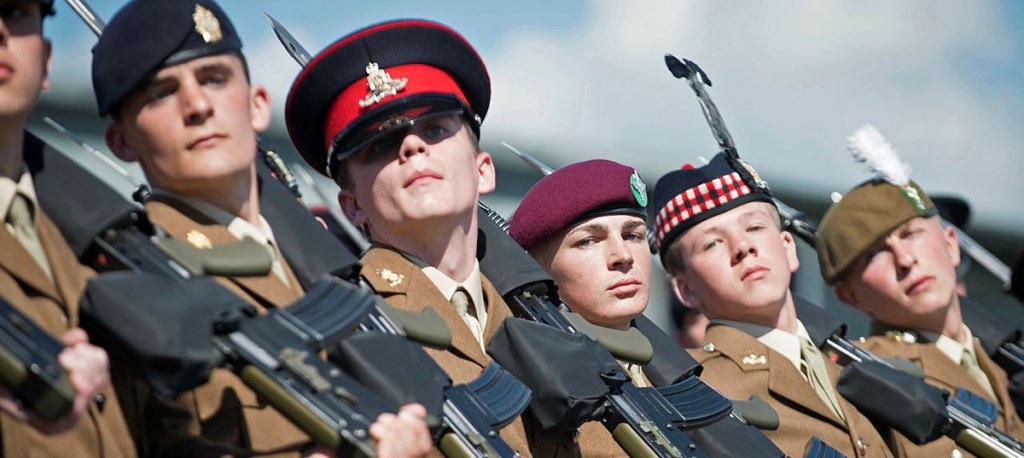
The child soldiers treaty put a stop to that, but nearly half of Britain’s new infantry recruits were still legally children, still being trained to kill. Photos of Britain’s own child soldiers paraded for the cameras provoked me to wonder where the line between opportunity and exploitation lay. Veterans’ stories took me behind the glossy PR curtain, where Britain’s teenage recruits live in daily fear of an arbitrary smack around the head or a petty humiliation on a corporal’s whim. I learnt how the coercive techniques of military conditioning remove conscious thought from the act of killing, and watched videos of Britain’s own child soldiers thrusting their bayonets through sacks shouting, ‘Kill! Kill! Kill!’
I wanted to act on this in some way, though I knew nothing about it. No systematic research of British military recruitment existed and I couldn’t find anyone willing to pick the issue up, so I decided to look into it myself. The Rowntree Trust – Quakers again – gave me a small grant to make a start. I had a single research question: Does the information given to young people by the armed forces enable them to make an informed choice about a military career?
The answer, of course, is no. The press release for the published report – ‘Army misleads recruits’ – led the morning news and hit headlines nationwide and even beyond. No one was more surprised than I. I did 25 interviews that day. Afterwards, I kept finding myself back in radio and TV studios to address miscellaneous military subjects I knew little about, simply because the journalists couldn’t find anyone else to challenge the armed forces on their practices.
Since then, it hasn’t been such a lone effort, as I’ve worked with veterans, campaign groups, and human rights organisations on a shared campaign to raise the minimum age of military recruitment in the UK to 18. Today, this work sits with the Child Rights International Network (CRIN). With characteristic patience, Quakers still fund it.
We’ve had a few successes. Early on, we appealed to the armed forces minister to give all recruits under age 18 the legal right, hitherto denied them, to leave the military. Against the advice of all his aides, he agreed. When he was sacked a few weeks later I wrote to thank him: thousands of young recruits would benefit from his political courage. His name is Nick Harvey.
We’ve since built a strong case for change from every angle — ethical, social, financial, and even military — and cultivated vocal support in Westminster for a long-overdue transition to all-adult armed forces in the UK. Unfortunately, the drift of British politics has left many in parliament who agree with us fearful of human rights as ‘woke’, but I believe we’re getting there.
To push things down the road, we shine a very public light on the army’s training centre for 16-year-olds, the quaintly misnamed Army Foundation College in Harrogate, whose record is riddled with child abuse. Its longstanding culture of maltreatment is baked into twisted training pedagogies that trade on humiliation and punishment, compounded by frequent alleged and proven incidents of gratuitous physical and even sexual abuse by staff. (Just last year, a corporal was convicted of the sexual abuse of several female recruits; abuses he had continued unchallenged over ten months.)
In my own time, I manage a well-used website, BeforeYouSignUp.info. It’s the only place online where a potential recruit can see the draconian contract of service, which the army refuses to put on its own website. I get emails every week from parents of young soldiers who are trying to leave the army but find the door bolted, and I help them to get out. And if a soldier’s being thrown out against their will – often because a bit of marijuana has shown up in a drug test – I help them to stay in.
Internationally, now that the pioneers of the child soldiers campaign have moved on, my work with CRIN now extends to other countries. Working with a Geneva colleague, Derek Brett – Rachel’s husband – we present evidence to the Committee on the Rights of the Child on military-involved children worldwide. Among the common problems we uncover are the use of children by non-state actors like insurgencies and organised crime networks, the indoctrination and abuse of children in military schools, and in countries like the UK and US, the harms associated with ongoing child recruitment into the ranks of their armed forces. The Committee puts this evidence to governments and calls on them to clean up their act. Occasionally, one of them does.
‘Hopeful work’
The work can feel slow, even stuck. But zoom out and the movement is undeniable. After children worldwide were pressed into war for millennia, the practice was mostly stopped in a tiny fraction of history by a tiny number of people. Taking the place of the old generals who said they would always use children in war are new generals who say they would never even contemplate it. Evidently, we don’t always lose. The work now is to press this change home, at least while it remains possible to try.
To close with a personal query, I wonder what to make of all this as a story of ‘hopeful work’ to call my own. I’ve sometimes heard this kind of work described as self-sacrificial labour, other times as the self-indulgent meddling in the lives of others. I find a grain of truth in both extremes, though neither fits the whole picture very well – the work is not so costly as to be called a sacrifice, nor so influential as to be an indulgence. It swept me up, is all. Since then, I’ve felt involved, in a small way, in the life of the world. I’m thankful for that.
Further reading
- For an overview, I’ve written most of the Wikipedia page for the child soldiers treaty. This gives a little more information about the international campaign between the 1980s and the text’s eventual adoption in 2000. The treaty has the unappetising title of Optional Protocol to the Convention on the Rights of the Child on the involvement of children in armed conflict.
- For more about historical Quaker interest in this issue, read Dorothea Woods’ short article in this 1991 issue of Friends Journal.
- For more about today’s work, see ‘Ending the military use of children’ on the CRIN website.
My main written sources for the international campaign are:
- J Becker, Campaigning for justice: Human rights advocacy in practice (Stanford University Press, 2013).
- B Phillips and J Lampen (eds.), Endeavours to mend: Perspectives on British Quaker work in the world today (London: Quaker Books, 2006).
Acknowledgements
Michel Mégard, archivist for the Quaker United Nations Office (QUNO), and Rachel Brett, now retired from QUNO but still engaged in other neglected human rights causes, have helped to clarify some points for me. Any remaining errors are of course my own.
Thanks also to Derek Brett and Arzhia Habibi for feedback on an earlier draft of this post.
Other talks from the ‘Untold stories’ gathering
- Read Phil Pritchard’s short reflection on the 1990s roads protests, a six-minute read.
- Read Sue Vermes on building a school community in a context of economic deprivation, an 11-minute read.
News
Audiobook. An audio version of my book Hope’s work, read by me, is available on Audible.
 Hope's work