Cultivating a learning community
Sue Vermes
Hello again friends. Here’s the second of the three short talks given at Untold stories of hopeful work at Oxford Quaker Meeting House in October 2023.
Former head teacher Sue Vermes begins her post with the severe challenges facing families living under economic deprivation and the various pressures on today’s educators, before describing the transformation that she witnessed emerge from a determined ethic of care in a troubled primary school.
Sue’s post is an 11-minute read.
Into teaching
Ever since childhood I had planned to be a teacher. My parents valued education very highly. My mother, from a working-class background, was the first person in her family to go to university. She became a teacher, and then a headteacher, working in Special Schools. My father was a Jewish refugee from Vienna. His family were looked after by Quakers and we were brought up initially attending Quaker Meeting. I believed that school and education in its broadest sense could have an impact on individuals, and more widely on creating a more humane world.
I had a privileged upbringing and always wanted to work in a context where I could ‘pay something back’. My preference was to work in schools in areas of disadvantage. Experience with children in these schools showed me that how they were treated and how learning was delivered could have a huge impact on their belief in themselves and their academic attainment.
Rose Hill
The headship at Rose Hill Primary on the outskirts of Oxford had been advertised twice. I had applied the first time and withdrawn, fearing the size of the challenge. The second time round I applied again and was appointed, not without worry about the scale of the task.
When I started in September 2014, about half of the children came from backgrounds among the 20, or even 10, percent ‘most disadvantaged’ in the country, economically and socially. We had families living in poor-quality houses of ‘multiple occupancy’ with a family in each bedroom. Many struggled to afford even clothes and food, many lacked adequate bedding and children’s toys. Sometimes, the sharing occupants were drug users, around whom parents would feel anxious for their children’s safety. One single mum with four children could not put her baby down on the floor in case she was bitten by the rats. One time, a toddler fell from a first-floor window when their mum was unwilling to take them to the shared kitchen to prepare a meal.
Since Rose Hill is on the edge of one of the most affluent cities in the UK, housing, transport – everything, really – is exceptionally expensive for people who live there. These families rarely see themselves as living ‘in Oxford’ and many children have never been into the city centre, even by nine or ten years old.
Facing ‘austerity’
From 2010, the coalition, and then Tory, government had implemented austerity measures, cutting funding to public services in stark contrast to the Blair/Brown governments before them.
It was clear to people working in schools like Rose Hill that the government had no concern for families living in poverty. It showed no awareness either that social and economic factors would influence children’s outcomes at school and their wellbeing. For example, so-called ‘value-added’ measures were removed; these had been used to show how children from poorer backgrounds had made progress. The attainment of our ‘disadvantaged’ children in SATs tests was compared unfavourably to ‘non-disadvantaged’, with the implication that responsibility for the difference rested with schools.
The government had changed the Department for Children, Schools and Families to the Department for Education. The DFE had a reductive view of humanity and children, treating them as ‘economic units’ to be fitted with the ‘knowledge’ needed to ‘function’ in the workplace. Creativity, arts, and a broad education, especially the capacity for independent thinking, were valued less, if at all. Children were referred to as ‘pupils’ from the age of three and teachers were judged on how well they imparted ‘knowledge’ – very narrowly interpreted – into their waiting heads.
The government and local council also wanted all schools to become academies. In particular, schools judged ‘inadequate’ by Ofsted had to be ‘academised’, which meant putting schools under direct management by the government. Private companies with highly-paid executives could treat groups of schools as one entity, greatly reducing the autonomy of head teachers to meet the needs of their catchment.
Ofsted was supposed to be an impartial judge of quality, but in reality was responsible for ensuring that government policy was implemented. The individuality and preferences of children were seen as irrelevant. For example, Ofsted’s handbook defines ‘learning’ as ‘an alteration in long-term memory’. This echoes the metaphor of humans as computers. I could not see as a head teacher how this was valid in the case of so much that we count as actual learning, such as driving, piano-playing, or writing, for example.
Austerity cuts had also drastically reduced other services for children, such as social care, mental health, and dental health. Children with serious psychological or psychiatric disorders were having to wait two, sometimes three years for their first appointment with mental health services. Social care was overwhelmed and only able to offer support where the law was being broken. Meanwhile, the Sure Start children’s centres introduced under the previous government, which had started to have a positive impact for children’s development and welfare, were about to be lost in Oxfordshire due to severely reduced funding for local authorities.
As these services were cut, their responsibilities were being loaded onto schools. In addition to the thirteen subjects in the primary curriculum, we were now expected to look after children’s use of social media, their development of relationships, and their sex education. Staff felt an enormous burden of responsibility. As government indifference added extra pressures on families, schools were asked to make more effort still to cure the damage caused.
Learning from the early years pioneers
I went into the headship at Rose Hill after 12 years as headteacher in two nursery schools. As an ‘early years’ practitioner, I was concerned then with the care and education of children from birth up to age five. I made the move to Rose Hill because I believed that the philosophy of the best early years pioneers could also be taken into a primary school. I would summarise that philosophy like this:
- Children are valuable, young, human individuals.
- Education should nurture individuality, creativity, resilience and thinking – the ability to empathise and be part of the social world.
- Children are part of faulty families and faulty schools, but most of these are trying their best.
- Children can think things that adults have never thought of.
- Play is a great way to learn.
- Talking is a great way to learn.
- Joining in with other children and adults doing things is a great way to learn.
- Playing and learning outdoors is natural and healthy.
How we worked
- At Rose Hill, my colleagues and I acted on our shared belief that school is a construct. It is inevitably an institution, but we could do our best to reduce the worst impact of this.
- Children’s behaviour arises from their feelings, which come from their needs. Children whose needs – physical, emotional, and social – are met mostly, are less likely to be unkind or unable to meet the school’s expectations for social behaviour.
- General practice in schools is to have a ‘behaviour policy’, ascribing ‘choice’ and moral values to children’s actions. Our ‘relationships and behaviour policy’ acknowledged that ‘behaviour is communication’. We did not subscribe to behaviourism and so applied no external rewards or sanctions, or fixed consequences for actions. We thought about, and asked the children, and each other, what was happening to make them unhappy, and what we could do about it. For example, restlessness in class could be because the child felt that the work set was too hard or too easy, and we could change this. Sometimes a child was simply too hungry or tired to concentrate, or had had an argument in the morning with a parent which was still troubling them.
- We acknowledged our own difficulties and helped when staff members felt angry or hopeless. A teacher or teaching assistant could call for help from another adult if a situation was causing them stress, and they were allowed and encouraged to talk about what they were finding difficult so that we could support them.
- We wanted our children to feel successful and excited about learning. Lessons were carefully planned to involve a range of activities in addition to sitting and listening. Children could use objects, go outside, talk with others and their teachers, and record their learning in a range of ways. Along with an understanding of their emotional state, these pedagogical tools formed a yin/yang: complementary aspects of a good school experience.
- Many of our children were short on experiences and language to help them to understand abstract ideas. All in all, we tried to make their experiences in school concrete, appropriate, and exciting. Teachers made use of visits to local sites and museums, worked in the forest school area, and invited interesting visitors to help topics come to life.
Impact
- Before I started, the school had had two or three years of upheaval. Children were very unsettled, often out of class, fighting in the playground, causing destruction to the school environment and disruption in lessons. There had been unfilled teaching posts, resulting in successions of struggling supply teachers. It took us a year to settle the school down, and another year before we felt that the policies had taken thorough root. After this challenging transition, our children began to feel happy and secure in school in general.
- After this, adults in the school were focused on children and were nearly always kind. The children said ‘hello’ to us in the corridors because we greeted them by name. Visiting teachers were sometimes surprised by our policy of greeting each other. Other schools in the area expected children to walk the corridors in silence with their hands behind their backs.
- We gave children the chance to love reading, showing them the magic world of books. We listened to them and learnt from them. We saw – really saw – their immense potential. This was clear from the start but the conditions for it to flourish needed to be developed.
- We offered children outdoor learning in a forest school. We were treated brilliantly by so many kind people and were able to take the children to the theatre and on so many trips. We had musicians, artists, and scientists visiting.
- We gave children a voice via ‘philosophy for children’. This was all dialogue. Children who struggled to write could express the most profound thoughts. The teacher would bring in a stimulus: an object, picture, or video. Children would then generate questions relating to the stimulus, and vote anonymously on which question to debate. The teacher would sit on the edge of the group and the debate would be regulated by the children (e.g. each speaker would choose the next speaker from those who had their thumb raised.)
- The other teachers and I gave our time to listen to the children and they trusted adults to listen to them. We tried to practise ‘unconditional positive regard’. This meant that there could be a fresh start after any problem, that adults focused on children’s good qualities and expected the best of them.
- We taught explicitly, and tried to model, a system of humane values: ‘empathy’, ‘compassion’, ‘tolerance’, ‘children’s rights’, ‘human rights’, understanding of migration and refugees, among others. The joy and hope in this was that children seemed to have a natural positive response to these values.
- We tried our best to keep children in our school, even when their distress made them unkind to others.
- We respected the many diverse backgrounds of the children, who spoke between 30 and 35 different languages at home. But we did not hesitate to confront parents if we knew they were treating children badly.
- I felt that the difficult things many children had experienced was sometimes the grit in their oyster. We ran ‘Rose Hill’s Got Talent’ every year except during the pandemic. And Rose Hill did have talent – breathtaking singers, dancers, acrobats and comics, and academic learners and thinkers.
- As children started to feel valued, accepted, and settled, their energy and enthusiasm for what the school was offering them began to enthuse and reward us in turn. Given time, our children cracked reading and loved maths. In the four years before the pandemic, our attainment in maths and English at year six was very close to national averages, and our progress data was often significantly above average.
A deepened conviction
I had great personal satisfaction from seeing our children thrive and enjoy school, and for many years working with a passionate, principled and highly skilled team. The frustrations were many, usually arising from outside school: from the academy trust or local authority, government policy, and Ofsted dogma.
But from my years at Rose Hill Primary I took the deepened conviction that all children, and especially those facing difficulties in their home lives, benefit from an approach which puts their humanity and their unique qualities at the forefront of planning for their education.
about the author
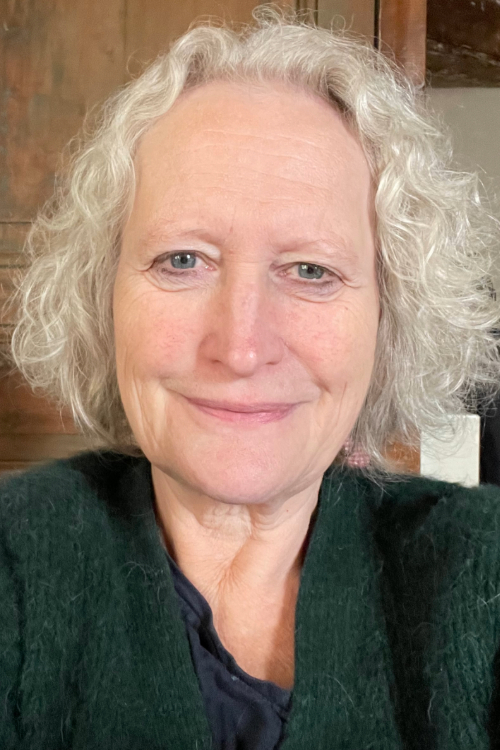
Sue Vermes was brought up in Manchester and studied classics at Oxford University before training as a primary school teacher. She worked first as a teacher, then for twenty years as a headteacher in early years and primary education. Sue now divides her time between Oxfordshire and France.
A Guardian long read profiles Sue and the staff at Rose Hill Primary – it’s well worth the read!
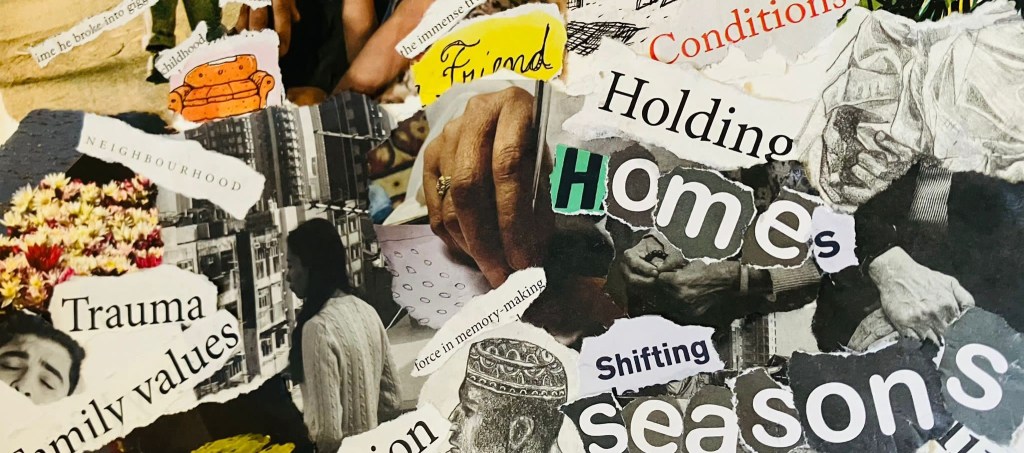
Collage: Arzhia Habibi, 2024.
Up next
Please share this post using the buttons below.
Missed the first talk from the Untold Stories evening? Phil Pritchard’s reflection on the 1990s roads protests is a six-minute read.
In a couple of weeks, I’ll publish the third and last talk: my own, on 50 years of work to stop the use of child soldiers. Subscribe to the Hope’s Work blog now to catch it.
News
Audiobook. An audio version of my book Hope’s work, read by me, is now available on Audible.
 Hope's work