A reflection on the roads protests of the 1990s
Phil Pritchard
After a long break, hello!
Back in October, about 60 people gathered at the Oxford Quaker Meeting House for an evening of ‘Untold stories of hopeful work’. We heard three personal journeys of hopeful commitment and explored together the meaning of such work in a world under growing strain. Here’s the first of those short talks, from Phil Pritchard.
Phil began campaigning for the environment, peace and social justice in 1992, and is still involved in work to promote positive human cultures that look after people and planet. A permaculture activist, Phil works at a city farm and volunteers with a charity offering mentoring to young men at risk of or involved in the criminal justice system called A Band of Brothers.
Phil’s post is a six-minute read.
I have a bit of a problem with ‘hopefulness’. The word ‘hope’ to me has a slight air of resignation, a passive detachment and abdication of my power or personal agency to act, to make change happen. Hidden in the word, I feel a sense of waiting for someone else to sort out the issues I see rearing their head on the horizon, or closer to home.
In the early 1990’s, I met some edge-dwelling people who were owning their agency and acting themselves. We gathered to challenge government road-building policy and to protect a beautiful, orchid-laced, ancient landscape on the edge of Winchester from a planned six-lane motorway, the M3 extension through Twyford Down. I was inspired by Ted Oakes’ stories of old-growth forest protectors’ blockades in British Columbia, and by anti-road activists in the French Pyrenees taking direct action against a new tunnel in the Vallée D’Aspe.
At the heart of our actions, our hope, our wish, was for the Earth, the Land, and Nature to be protected, valued, and held safe for the future generations of all life.
Getting involved for me was personally a life changing experience, a one-way doorway into a new way of seeing the world.
DAFT, The Dongas Autonomous Free Territory, named after the ‘Dongas’ trackways, a wild space where we’d made our camp, had declared independence from Tory England. The super-empowered Dongas Tribe of characters had gathered from around the country. We sat in front of dumper trucks, climbed on diggers, and flooded the road-building site by redirecting a river. We squatted houses scheduled for demolition and in a process of reverse evolution moved back up into the trees to protect them from the chainsaws.
We locked ourselves to machines, defied court injunctions, and used court cases to communicate our shared defiance that we were not the criminals. We were arrested, we were imprisoned, and we carried on. Direct action spread from Twyford Down to Whatley Quarry in Somerset, where the road stone was quarried, and to other road-building schemes in Newcastle, London, Devon, Bath, Surrey, and Birmingham.
There was a sense in me of urgency, purpose. I felt I was part of an immune response, protecting life on Earth: an antibody defending life. We took on the dominant culture, challenged the destruction of Sites of Special Scientific Interest, Scheduled Ancient Monuments, put our bodies, emotional wellbeing, and freedom on the line. The protests were characterised by ‘noisy defeats and quiet victories’, as one commentator said. Thousands of people heard the call to action and although most of the road schemes that we challenged were eventually built, the majority of the government’s road-building programme was scrapped.
Not everyone made it. The scale of the adversary, the advance of industrial capitalism broke people. Burnout from emotional pressure, lack of sleep, inadequate food, and the desperate urge to resist led some of us to breakdowns, depression, and even suicide. Getting to know a beautiful woodland. Foraging sweet chestnuts. Singing. Building a home there. Then seeing it reduced to stacks of smouldering tree trunks, stacked irreverently and ignited with cans of petrol. It was heartbreaking. My own tears of grief flowed many times.
‘If you are not outraged, you are not paying attention!’ was the caption in a Road Alert! newsletter. This resonates with me, and with the lyrics of a Manic Street Preachers song: ‘If you tolerate this, your children will be next.’
Music, song, and camp culture were a big part of the road protest movement. I heard at one point that fake climbing harnesses were being worn in nightclubs in London – maybe road protesting counterculture was cool! A sister campaign to save a woodland right in the path of the new Newbury Bypass was the biggest news story of 1996.
We discovered that behind the destruction stood the forces of corporate capitalism, neoliberal economics, and the industrial military complex: altogether a formidable foe. That knowledge unfolded gradually for me, and my understanding of how political frameworks used the law and police as tools for their own interests was a revelation.
The environmental direct action anti-roads movement spawned, grew into, and overlapped with the peace movement, Greenham Women, Campaign Against Arms Trade, global anti-capitalist movements, the Occupy Movement, campaigns against technologies of control – genetically modified organisms, mega-dams, deforestation, pesticides – as well as struggles for labour rights, such as the solidarity actions with the Liverpool dockers and Underground workers. Our actions connected into Reclaim the Streets, Advisory Service for Squatters, early housing rights activists, and Friends and Families of Travellers.
The campaigns against Manchester and Heathrow airport expansion, The Land is Ours, Reclaim the Power, Extinction Rebellion, Rising Tide climate change awareness and campaigning, and Climate Camp, all grew from this hotbed of urgent, motivated, and determined activism.
For me, my righteous anger morphed into the world of permaculture design and community building, housing cooperatives, and autonomous organising. I have learnt that Nature can regenerate quickly given space and time. Seeing the ‘refutrees’, which I had rescued from the route of the Newbury Bypass and transplanted in 1996, grow to over five metres tall, have my friends’ children climbing in them, and the trees bearing their own acorns, gives me hope. Seeing the transformative regreening of deserted land by permaculture design and community action guides me in creating a positive ‘design alliance’ with the ever emerging natural world. The forces of nature are powerful.
I see echoes of our 1990s protests in the Stop HS2 protest camps and know that my life is richer for taking part in empowered action. So, action is a route to hope. Here’s a quote from Margaret Mead:
‘Never doubt that a small group of thoughtful committed citizens can change the world, indeed it is the only thing that ever has.’
What are they doing now, those 1990s roads protesters? Many I meet are nurturing a love of the natural world in young people, sometimes by setting up food growing projects in schools. Lots are involved in building a network of skilled, agro-ecological farmers who produce food with short supply chains and leave space for nature. Others are campaigning for better public transport and safer provision for cyclists. Some have stepped into the world of academia and local politics.
The Earth, our life force, is still under attack. The alarm we raised in the 1990s is still ringing, and it’s louder and more urgent. It’s clear to me that turning the music up louder to drown out the alarm is pointless. It’s clear to me that systemic change is needed to break our personal and societal addiction to fossil fuels. I want to be a good ancestor to future generations.
We came together and chose to act; I think that is a good route to an active hope. What fires you up and makes your heart sing?
Photo
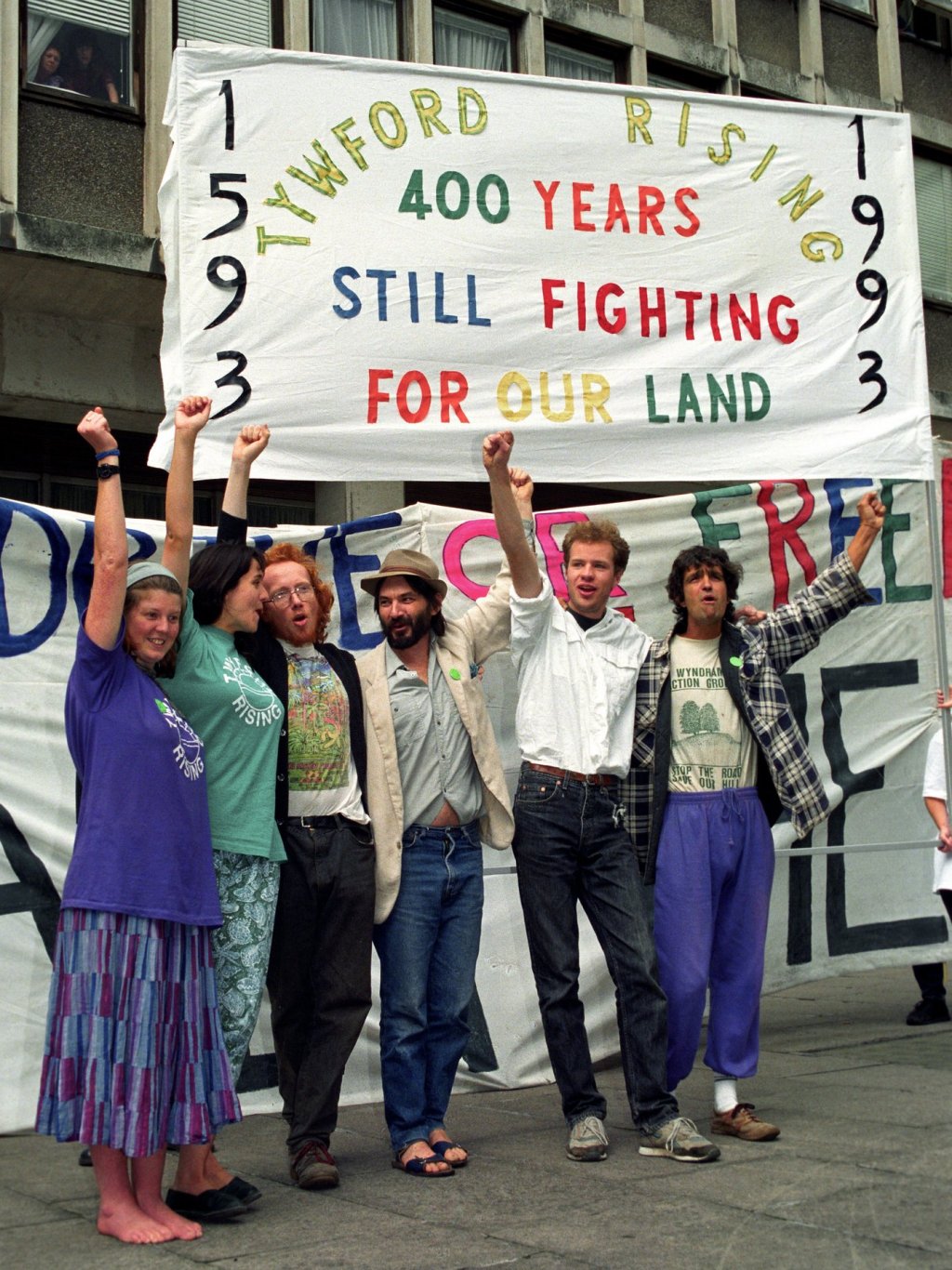
Phil and six friends appear outside the Department of Transport on the day they are released from their imprisonment for protesting at Twyford Down, 1993.
Left to right: Becca Lush, Emma Must, Phil Pritchard, Simon Fairlie, Jason Torrance, Bob Baehr.
Photo credit: John Stillwell / Alamy.
Up next
If you found this post worth the read, you can share it easily using the buttons below
I’ll publish the next Untold stories talk, by former head teacher Sue Vermes, in a couple of weeks. Sue tells of her and her colleagues’ work to transform a troubled primary school into a thriving learning community through a determined ethic of care. Subscribe to the Hope’s Work blog now if you want to catch it.
News
Audiobook. An audio version of my book Hope’s work, read by me, is now available on Audible.
 Hope's work